Your Discipleship Course Finished. What Happens Next?
The final session goes well. Then the participant goes from a structured six-week experience to no obvious next step at all.
5 min read
The final session finishes well. There might be a certificate, a group photo, a round of applause. Then the participant goes from a structured, weekly experience with clear content and a clear next step to nothing obvious at all.
This is one of the more overlooked gaps in church discipleship. A lot of thought goes into designing the course itself. Comparatively little goes into designing what happens the week after it ends.
Completion isn't the same as arrival
It's easy to treat finishing a course as the goal. In practice, finishing a course is usually a milestone inside a much longer journey — and if nothing is designed for what follows it, the person who just invested six weeks of attention is left to work out their own next step, often at exactly the point their momentum is highest.
What it feels like from the other side
From a participant's perspective, finishing something meaningful and then hearing nothing back can quietly change how the whole experience gets remembered. Even a genuinely good six weeks can end up filed away as "that course that didn't really go anywhere," not because the content was weak, but because nothing came after it to confirm the investment had mattered.
This is also the point where momentum is easiest to lose and cheapest to keep. Someone who has just built a weekly habit of showing up, engaging and finishing something is, for a short window, unusually open to being invited into whatever comes next. Wait even a month, and a church isn't just making a delayed invitation — it's asking that person to rebuild a habit that used to cost nothing to extend.
Four questions every pathway should be able to answer
Before launching or re-running any course, a leadership team should be able to answer these without hesitating.
- What is this journey actually for? What should be different for someone by the end of it?
- What does completion mean operationally — not just emotionally, but in terms of what the church now knows and does about that person?
- What should someone be invited into next, specifically? Not "stay involved," but a named group, role, or pathway.
- Who owns making that invitation happen? Completion without an owner for the next step tends to just end.
Most of the value here comes from question three. A church that can name the next step for every current pathway has already solved most of the disengagement-at-completion problem, before anyone even finishes the course.
Designing a simple progression map
This doesn't need to be complicated. For each current pathway or course, write one line: "After this, most people should be invited into ___." Some paths will branch — that's fine, as long as each branch has an owner and an invitation attached to it, rather than being left as a theoretical option nobody actually offers.
- A new believers course might lead into a small group, a baptism preparation journey, or both.
- A leadership pathway might lead into an actual serving role with a named leader overseeing it.
- A prayer-focused pathway might lead into a prayer team, or simply a second, deeper pathway on the same theme.
The point isn't to build an elaborate flowchart. It's to make sure nobody finishes something significant and is met with silence — the same principle behind giving newer attenders a visible path in From First Sunday to Belonging: Giving New Members a Clear Pathway.
How to put this into practice in ChurchPathways
A church using ChurchPathways typically holds several pathways side by side in its library — a new believers journey, a leadership pathway, a prayer-focused pathway, and others specific to that church.
A church typically holds several pathways side by side in its library. Once someone completes one, a leader can assign a different pathway directly, rather than leaving them without an obvious next step.
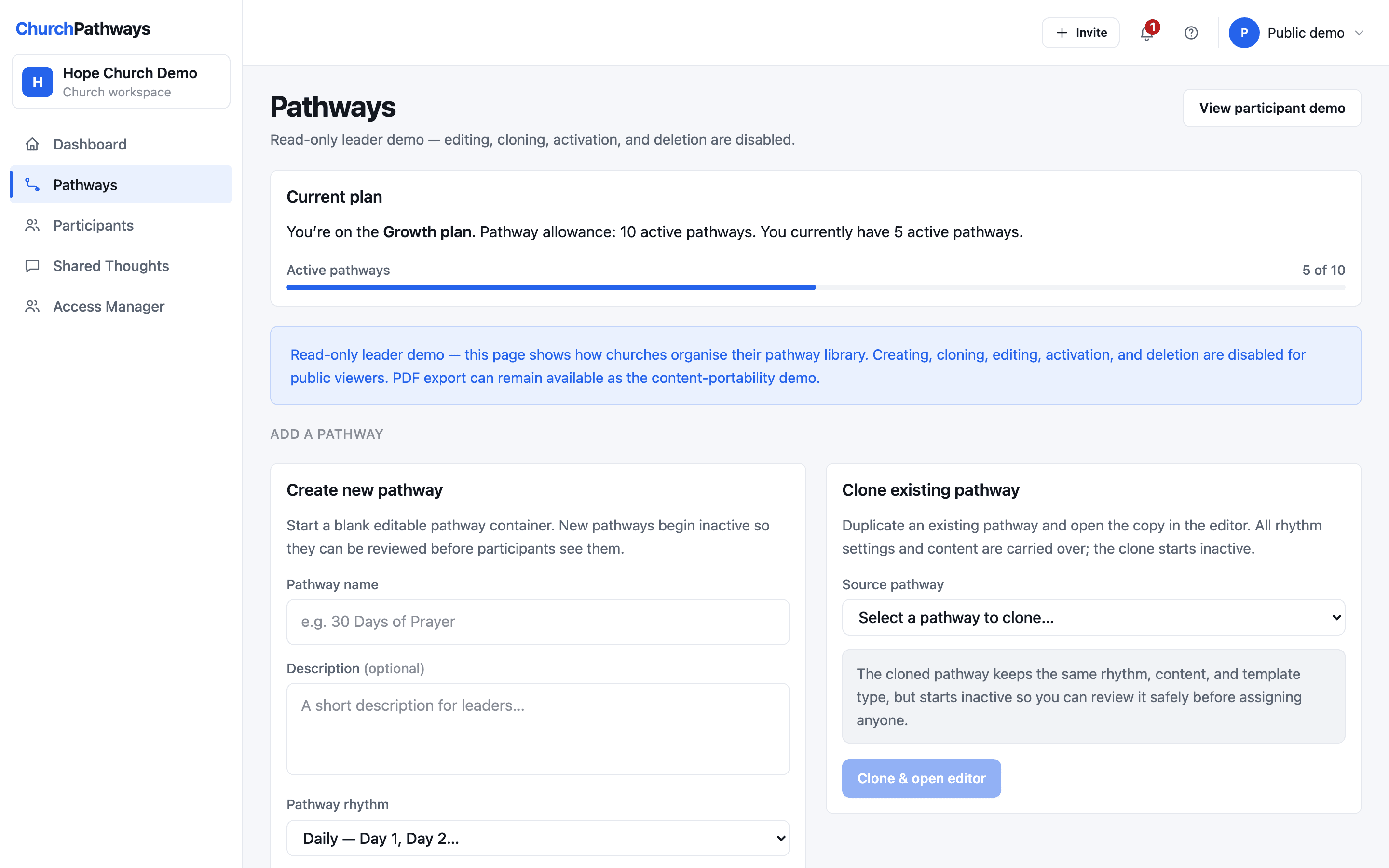
This doesn't replace the decision of what the right next step is for a particular person — that's still a leader's judgement. What it removes is the operational friction of actually making the next journey available once that decision has been made.
Try this this week
Pick one course or pathway your church currently runs. Write down, in one sentence each: what completion means, what someone should be invited into next, and who is responsible for extending that invitation.
Related resources