How Do You Grow Discipleship Without Creating More Administration?
Leaders want more intentional discipleship. Every new process sounds like another spreadsheet, another thread, another thing to remember.
5 min read
Leaders want more intentional discipleship. Almost every leader will say so. But every proposal to get there tends to sound the same: another spreadsheet, another message thread, another programme, another thing leaders have to personally remember to keep alive.
This is a genuine tension, not a failure of will. Discipleship depends on leaders' attention, and attention is the one resource that doesn't scale just because a church grows. The question worth asking isn't "how do we do more," but "how do we grow the process without growing what any one leader has to hold in their head."
A simple operating model
Most sustainable discipleship processes, however they're run, follow the same underlying shape.
- Create once — build the pathway, course, or process a single time, properly.
- Assign clearly — give it to the right people, without ambiguity about who's on it.
- The participant knows their next step — without needing to ask a leader what happens next.
- Leaders see meaningful signals — enough visibility to know where attention is genuinely needed.
- Follow up only where needed — leaders spend relational energy where it matters, not on administration.
Notice what this model doesn't ask a leader to do: manually track every person's progress in a spreadsheet, remember who's due a check-in, or re-explain the same next step to each new participant individually. The structure carries that weight so the leader doesn't have to — which matters most for churches facing the fragmentation described in When Discipleship Lives Across WhatsApp, Spreadsheets and Leader Notes, since consolidating that weight into one place is most of what makes this model sustainable.
Technology's actual job here
Technology should support discipleship relationships, not become the discipleship relationship. Its job is narrow: reduce coordination work, so more of a leader's time and attention goes to actual conversations rather than remembering who needs one.
That's a genuinely different goal from adding more features, more dashboards, or more things to check. Growth in discipleship should feel, to a leader, like more meaningful conversations — not like more administration wearing a discipleship label.
A quick test for any new process
Before adopting a new discipleship process, whatever form it takes, it's worth asking one honest question: what would a leader need to personally remember to do, every single week, for this to keep working? If the answer is a short list — check one inbox, respond where needed — the process will likely survive a busy season. If the answer is a growing list of manual habits spread across several tools, it will quietly decay the first time that leader is stretched thin, which for most church leaders is most weeks.
This test is worth applying retroactively too, not just to new ideas. Most churches are already running at least one discipleship process that has quietly become someone's personal responsibility to hold together — a spreadsheet only one person updates, a check-in habit that only happens because one particular leader remembers to do it. These processes tend to work fine right up until that person is on leave, overwhelmed, or moves on, at which point the whole thing stops rather than degrading gracefully.
How to put this into practice in ChurchPathways
The whole product is built around this same shape. A leader creates a pathway once. Participants are assigned or request access to it. Each participant sees their own next step inside their journey, without needing to ask a leader.
A leader creates a pathway once, assigns it to the right people, and each participant knows their own next step without asking. The Dashboard then gives leaders the signals that matter, so follow-up happens where it's actually needed rather than everywhere at once.
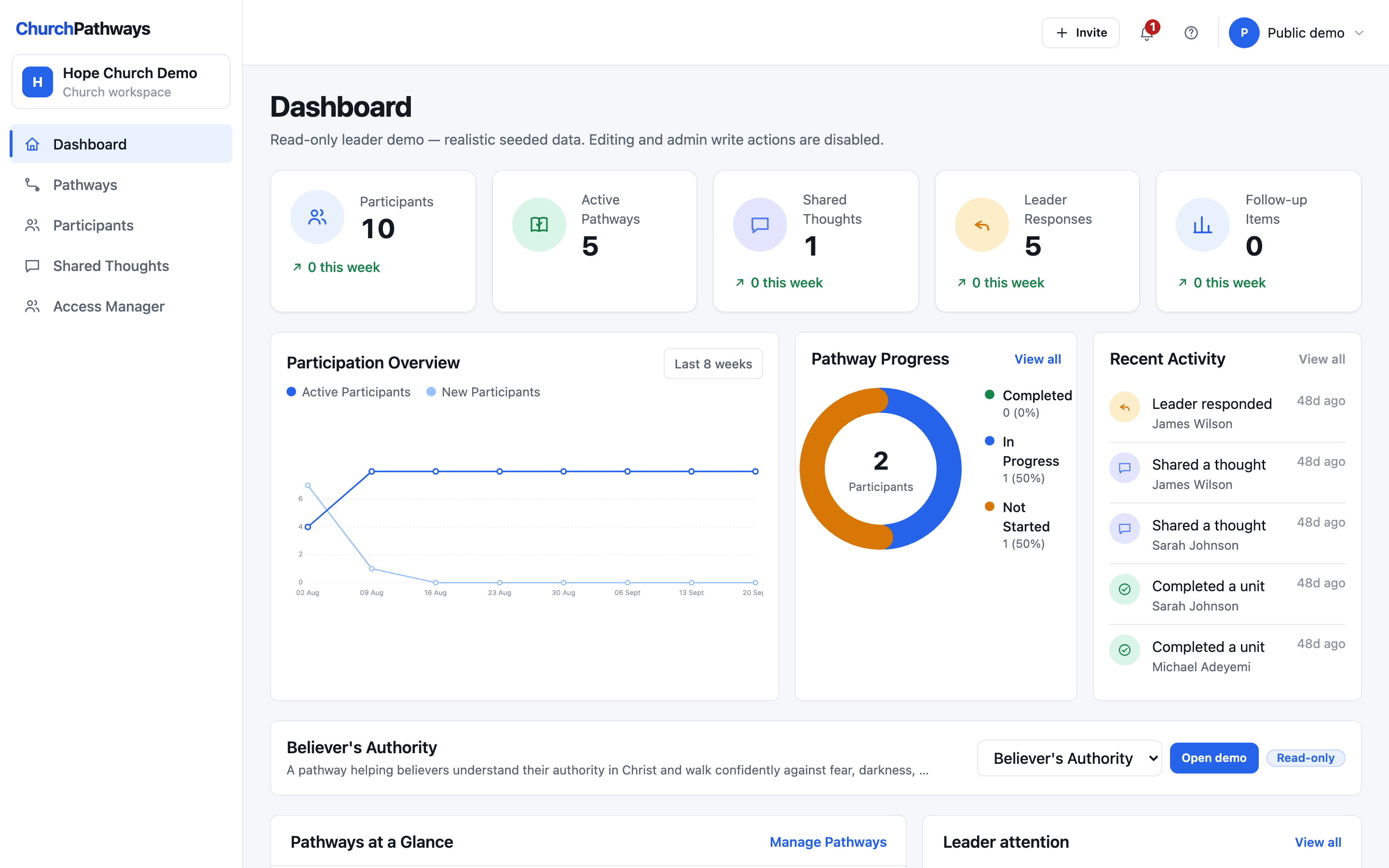
None of this replaces the leader. It's designed to protect their time for the part of discipleship that technology was never going to do anyway: the actual conversation with the actual person. Whatever tool a church eventually settles on, that's the test worth applying to it — not whether it does more, but whether it frees a leader to do less admin and more of the work only a person can do.
Try this this week
For one current discipleship process, ask: what would a leader need to remember to do manually every week to keep this running well? If the answer is more than one or two things, that's the part worth simplifying first.
Related resources