When Discipleship Lives Across WhatsApp, Spreadsheets and Leader Notes
The tools aren't the problem. The problem is that no single place shows what a participant's journey actually is.
5 min read
One leader has a spreadsheet. Another has a thread of WhatsApp messages about the same small group. A third just remembers conversations. Somewhere, a notebook contains notes nobody else has ever seen.
The instinct is to blame the tools. It usually isn't the tools' fault. A spreadsheet is a perfectly good spreadsheet. WhatsApp is a perfectly good messaging app. The actual problem is that none of them were ever meant to answer one specific question: where is this person, right now, in their discipleship journey?
Communication tools are not a discipleship process
A WhatsApp group is excellent for encouragement and quick coordination. It is a poor place to answer "has this person actually engaged with week three?" six months later. A spreadsheet is excellent for a snapshot at a point in time. It quietly goes out of date the moment nobody remembers to update it.
None of that makes these tools wrong to use. It means they are doing a job they were never designed for, and the strain shows up as fragmentation: five leaders, five partial pictures, and no single version anyone can trust.
A simple frame: one pathway, one stage, one next step
Whatever tools a church uses, the underlying process can stay simple. For every participant in active discipleship, a leader should be able to state three things without checking multiple places.
- One pathway — which journey they're actually on, not a general sense of "they're around."
- One current stage — where they are within it, so progress is a fact rather than an impression.
- One next step — what happens for them next, and who is responsible for it.
If any of those three requires piecing together a WhatsApp thread, a spreadsheet, and someone's memory to answer, the process is fragmented — regardless of how good each individual tool is.
Deciding what actually needs a single source of truth
Not everything needs consolidating. Casual encouragement can stay in WhatsApp. What deserves one visible, trustworthy place is the small set of facts that follow-up actually depends on: who is on which pathway, how far they've progressed, and whether anything they've shared is still waiting for a response.
A useful test: if two different leaders were each asked, independently, where a specific participant currently stood, would they give the same answer? If the honest answer is no, the underlying facts are still fragmented, however good any individual leader's own notes might be. That gap — not the choice of tools — is what's worth fixing first.
Why this tends to get worse with growth, not better
Fragmentation is often assumed to be a small-church problem that a bit more organisation will eventually fix. In practice it moves the opposite direction. A church with one pastor and thirty people can hold most of this in one person's head reasonably well. Add more leaders, more small groups, more overlapping ministries, and the number of places a single fact about one person could plausibly live grows faster than anyone notices, until even a well-organised church finds that no single person can answer a simple question about a specific participant without asking around first.
How to put this into practice in ChurchPathways
ChurchPathways doesn't try to replace WhatsApp or a church's existing communication habits. What it gives is the one place those three facts — pathway, stage, next step — actually live, visible to every leader with access rather than trapped in one person's phone.
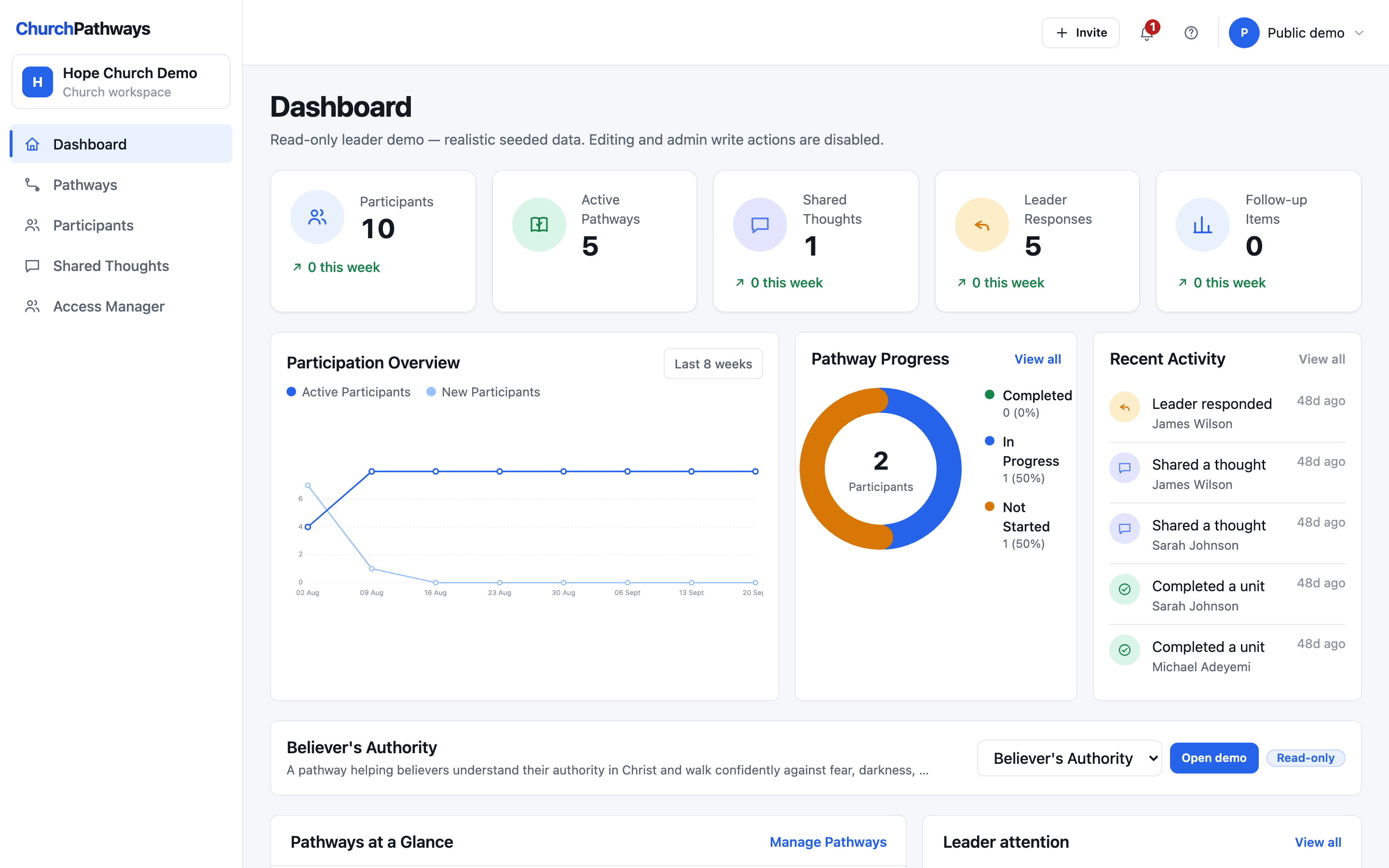
The Dashboard gives a leader one place to see how participants are moving through their assigned pathways, so a pause in progress is something a leader can notice rather than something they have to remember to ask about.
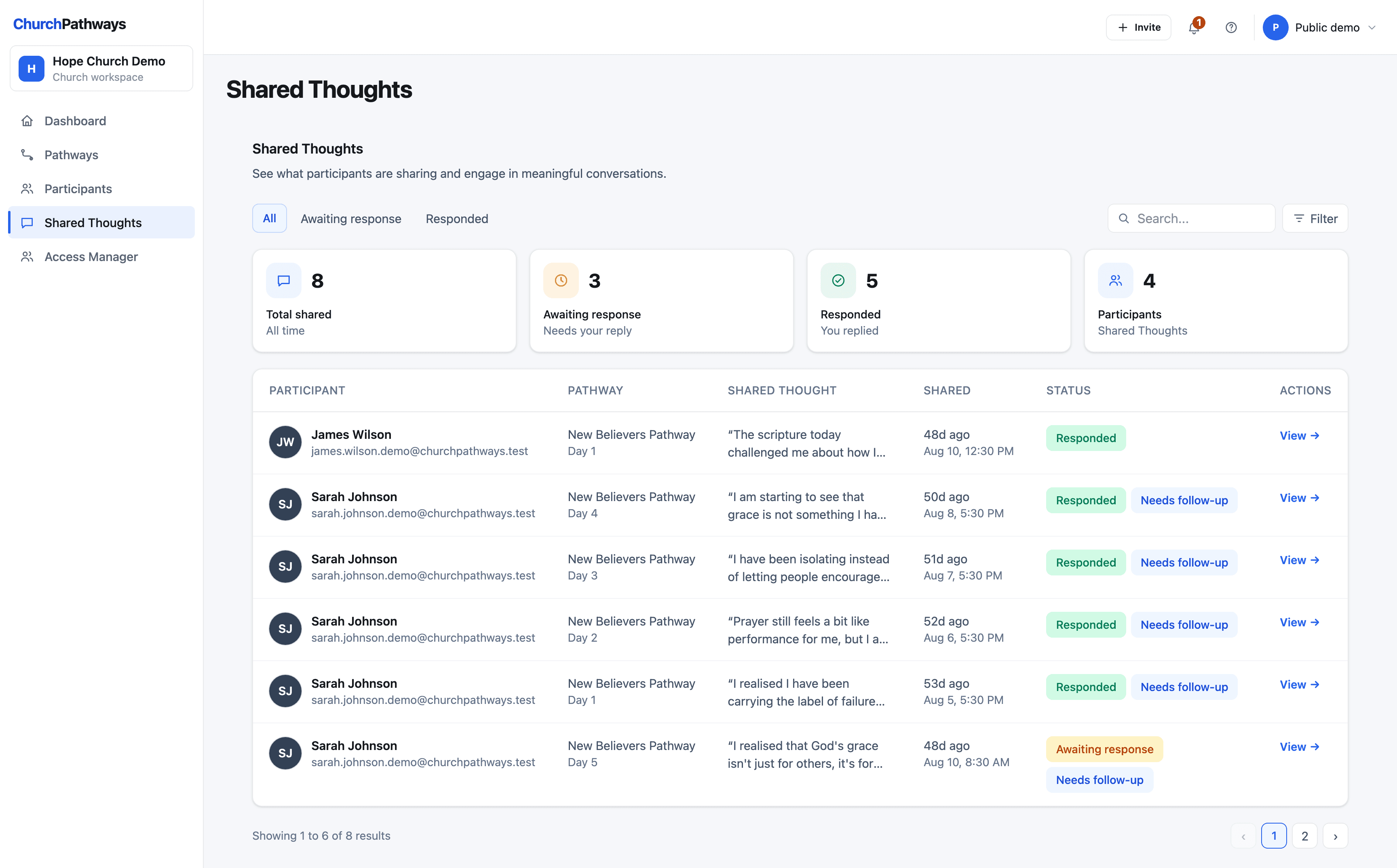
What a participant chooses to share arrives in one inbox for leaders, each with a status showing whether it's still awaiting a reply. Nothing written privately ever appears here — only what was intentionally shared.
The conversations themselves — the actual pastoral relationship — can stay exactly where they've always been. What changes is that the facts underneath those conversations no longer depend on which leader you happen to ask, which is also most of what keeps a growing church from drowning in admin — see How Do You Grow Discipleship Without Creating More Administration?.
Try this this week
Pick one participant currently going through a pathway. Try to answer, from memory alone: what stage are they at, and what's their next step? Notice how confident you actually are.
Related resources