Why People Start Church Courses but Don't Finish Them
Week one is full. By week four, a few chairs are quietly empty, and often nobody noticed exactly when.
5 min read
Week one is full. By week four, a few chairs are quietly empty, and often nobody noticed exactly when it happened. The pattern is common enough that most churches have simply learned to expect it.
The easy explanation is that people weren't committed enough. It's rarely that simple, and treating it as the whole story tends to close down the more useful question: what, specifically, made it easier to stop than to continue?
Operational reasons, not character judgements
A few causes show up repeatedly, and none of them require assuming anything about a person's commitment.
- Expectations weren't clear at the start, so the commitment felt bigger than it was signed up for.
- There was simply too much content for the pace of most people's lives.
- Progress was invisible, so there was no sense of momentum to protect.
- Ordinary life circumstances intervened — nothing to do with the course itself.
- A missed session created friction: returning felt like admitting you'd fallen behind, so it was easier not to.
- Nobody noticed early enough for a light-touch reconnection before it became a pattern.
The missed-session point deserves particular attention. For many people, the moment they miss one session is the moment they decide, quietly, whether they're coming back. A church that reaches out warmly at that exact point can recover a lot of people who would otherwise have drifted for good.
It's worth noticing, too, that these causes rarely announce themselves. Someone who feels behind after a missed week is unlikely to say so — they're far more likely to simply stop replying to reminders about the course. Reading silence as disinterest, rather than as a signal worth a gentle, specific check-in, is often where the drop-off becomes permanent — the same failure mode covered in When Church Follow-Up Depends on Who Remembers, just triggered by a missed session instead of a missed conversation.
The cost of treating every drop-off the same
A single blanket fix is the natural first response to drop-off — chase everyone harder, add more reminders, make the course shorter. It usually helps some people and does nothing for the rest, because the underlying causes are genuinely different. Someone who found the pace too fast needs a different response than someone who missed one session and felt awkward returning, and both need something different again from someone dealing with a difficult season at home.
A single blanket fix also tends to target the most visible cause rather than the most common one. Reminders address forgetting, which is real but rarely the biggest driver. The missed-session-then-awkwardness pattern is quieter and easy to miss entirely if a church has never specifically looked for it.
A practical intervention framework
This doesn't need to be elaborate to work.
- Notice — have a defined point at which absence gets flagged, rather than waiting for it to become obvious.
- Understand — a brief, genuinely curious check-in, not an accusation. Life circumstances are common and deserve to be asked about first.
- Remove friction — if content or pace is the issue, is there a lighter way back in rather than starting over from week one?
- Reconnect — a specific invitation back, not a vague "we missed you."
- Clarify the next step — make sure whatever comes after this course is still worth finishing it for.
How to put this into practice in ChurchPathways
Pathway progress gives a leader an early, observable signal — not a diagnosis. Seeing that someone has stalled partway through a pathway is a prompt to ask why, not an explanation on its own.
The Dashboard gives a leader one place to see how participants are moving through their assigned pathways, so a pause in progress is something a leader can notice rather than something they have to remember to ask about.
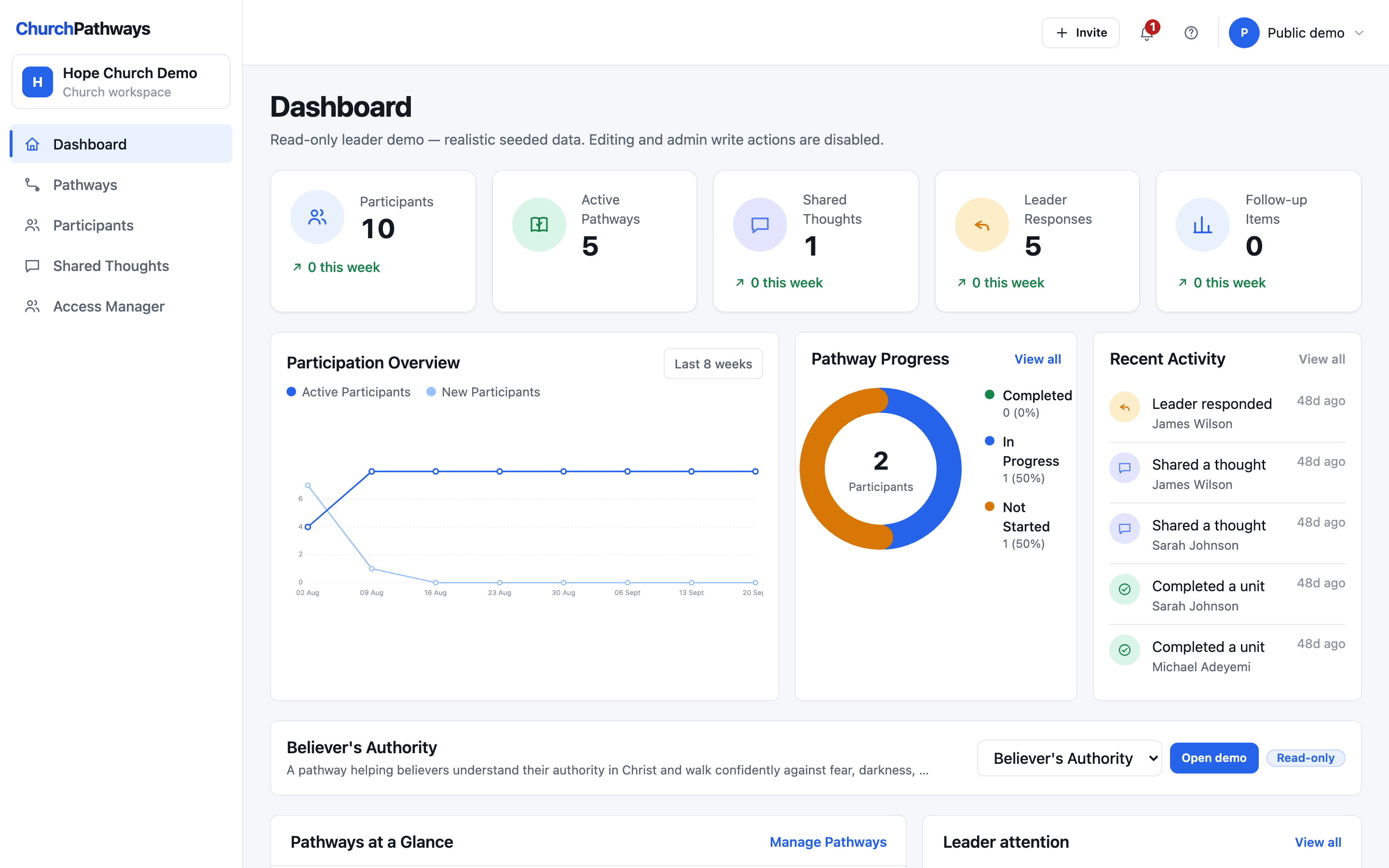
The software cannot tell a leader whether someone stopped because of a house move, a busy season at work, or genuine disengagement — that judgement stays entirely with the leader who knows the person, or is willing to ask. What progress visibility changes is how early that leader can notice there's a question worth asking at all, rather than discovering it weeks later when the pattern is already well established.
Try this this week
Think of the last course that had noticeable drop-off. For the people who stopped, write down your honest best guess for each one — was it content, life circumstance, or a missed session that made returning feel awkward?
Related resources