How Do You Know Whether People Are Actually Engaging With Discipleship?
Attendance tells you someone walked into a room. It doesn't tell you whether they're moving through the discipleship process you hoped they would.
5 min read
Attendance tells you someone walked into a room. It does not tell you whether they are actually moving through the discipleship journey you hoped they would.
This gets confused constantly, and understandably so. A full room feels like evidence of engagement. But a person can attend every session of a course and take nothing home, just as a person can miss a session and still be quietly working through the material on their own.
Five different things, often treated as one
It helps to separate what's actually being observed into layers, because each one tells you something different.
- Attendance — someone was physically or digitally present.
- Progress — someone moved through the material: completed a session, a day, a unit.
- Reflection — someone engaged privately with a question, whether or not they told anyone.
- Intentional sharing — someone chose to make part of their reflection visible to a leader.
- Leader response — someone in leadership engaged back.
A church that only tracks attendance is missing four other signals. A church that assumes attendance equals discipleship is drawing a conclusion the data doesn't support.
What this is not: a measure of someone's faith
This distinction matters enough to state plainly: none of these signals measure a person's spiritual condition. Progress through a pathway is an operational signal — evidence that someone is engaging with structured content — not evidence of the state of someone's heart.
A person could complete every day of a course out of habit and still be spiritually adrift. Another could complete very little and be walking closely with God in ways no system will ever see. Treat progress as a prompt for a leader to pay attention, never as a verdict.
Why churches default to attendance anyway
Attendance became the default signal for a simple reason: it's the easiest one to see. A leader standing at the front can count heads without any system at all, while progress, reflection and sharing all require some way of actually knowing what happened after someone went home. That ease is exactly why attendance gets treated as a proxy for everything else, even though it was never designed to carry that weight.
The fix isn't to distrust attendance. A full room is still a good thing, and noticing who shows up still matters. The fix is simply not asking attendance to answer questions it was never built to answer — and being honest, when a leadership team reviews how a course went, about which of the five signals they actually have any real information on.
Using the signals without over-reading them
Used well, these layers help a leader decide where their limited attention should go, rather than replacing their judgement.
- Someone attending but not progressing might need a simpler next step, not a stronger challenge.
- Someone progressing but never reflecting might be moving through content quickly without engaging it — worth a conversation, not a conclusion.
- Someone who shares something difficult deserves a genuinely thoughtful response, not a quick acknowledgement.
- A long gap in any of these signals is worth noticing early, before it becomes a pattern.
How to put this into practice in ChurchPathways
The Dashboard separates these signals rather than collapsing them into one number.
The Dashboard gives a leader one place to see how participants are moving through their assigned pathways, so a pause in progress is something a leader can notice rather than something they have to remember to ask about.
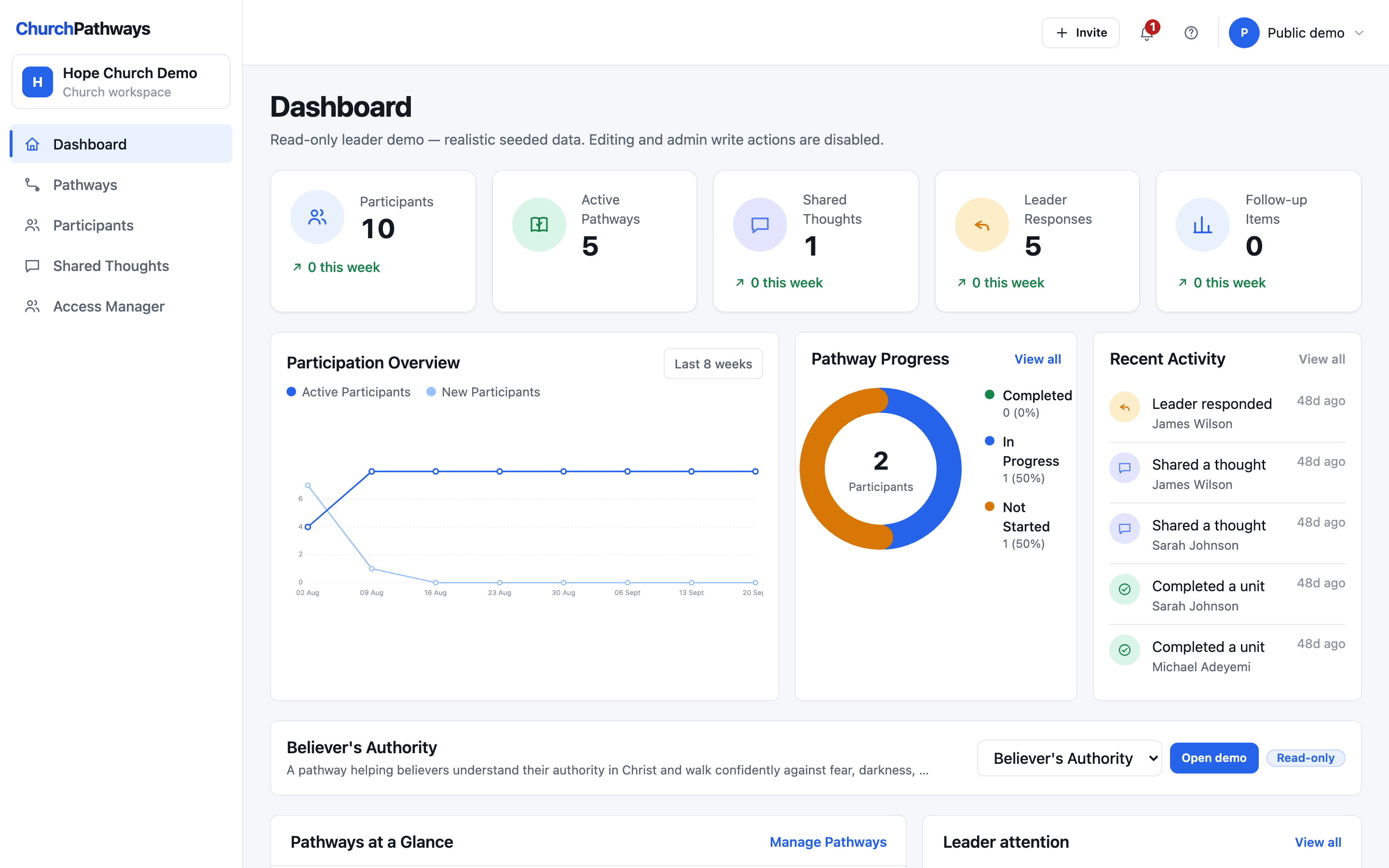
Reflection and intentional sharing sit separately again from progress, through the private response a participant writes each day and the distinct choice to share a thought with a leader. A leader never sees the difference between someone who reflected privately and someone who wrote nothing at all — that stays with the participant. What a leader does see is when someone has chosen to share, which is where their attention is genuinely being invited (more on that distinction in How Can Churches Support Personal Reflection Without Invading Privacy?).
Used this way, the product gives a leader better questions to ask, not a spiritual scorecard to read from. The judgement about what any of it means for a particular person still belongs to the leader who knows them.
Try this this week
Pick one current discipleship group. For each person, write down what you actually know: did they attend, did they progress through the material, and did they reflect or share anything. Notice how different those three columns look.
Related resources