How Can Churches Support Personal Reflection Without Invading Privacy?
The moment participants believe every sentence they write is automatically visible to a leader, the nature of what they write changes.
6 min read
Churches want discipleship to include honest personal reflection. But the moment a participant believes every sentence they write will automatically be read by a leader, what they write changes. People edit themselves for an audience. Genuine reflection often needs the opposite: the freedom to write something messy, half-formed, or difficult, without an audience at all.
This creates a real tension. Churches also want to know when someone is struggling, and want participants to feel able to bring that struggle to a leader. Solving that tension isn't about choosing between privacy and pastoral care. It's about being precise about which is which, and letting the participant decide when to move from one to the other.
Three genuinely different things
A clear discipleship process treats these as separate, not as shades of the same thing.
- Private reflection — written for the participant's own benefit, never seen by anyone else unless they choose otherwise.
- Intentional sharing — a specific, deliberate choice by the participant to make something visible to a leader.
- Leader response — a leader engaging thoughtfully with what was shared, once it has been shared.
The word that matters most here is intentional. Sharing should be something a participant does, not something that happens to them as a side effect of writing in the first place — it's the same distinction that matters when reading any engagement signal at all, covered further in How Do You Know Whether People Are Actually Engaging With Discipleship?.
Avoid fear-based framing
It's tempting to reassure participants with heavy privacy language — locked, encrypted, nobody will ever see this. Most of that isn't necessary, and it can quietly imply the opposite of what's intended: that sharing would be risky or exceptional, when really it should feel like a normal, welcome choice.
A simpler approach usually works better: explain plainly that what someone writes stays private unless they choose to share it, and that sharing is genuinely welcome whenever they want a leader involved. Calm and clear beats reassuring and dramatic.
Why privacy makes sharing more likely, not less
This can feel counterintuitive at first. Surely making everything visible to a leader would surface more, not less? In practice it tends to do the opposite. When people know everything is automatically seen, the honest, difficult entries are the first thing to disappear — replaced by whatever feels safe to have read. The private space isn't a barrier to pastoral insight; it's usually what makes the honest version of a reflection get written in the first place.
Intentional sharing then becomes more meaningful, not less, precisely because it was optional. A leader reading something a participant chose to hand over is reading a considered decision, not a byproduct of surveillance. That distinction is easy to miss from the leader's side, where a shared reflection just looks like information — but from the participant's side, it's the difference between being read and being trusted.
What this asks of leaders
If sharing is intentional, a leader has a responsibility once it happens: someone chose, deliberately, to bring you into something personal. A brief, generic acknowledgement can feel worse than no response at all. A thoughtful reply — even a short one — honours the choice that was made to include a leader in the first place.
How to put this into practice in ChurchPathways
Every day of a pathway gives a participant a private reflection question. What they write stays with them unless they take a separate, deliberate action to share it — and on the leader's side, only what was shared ever arrives.
Every day's reflection stays private by default. A participant only involves a leader through a separate, clearly labelled action, and a clear confirmation follows once they do.
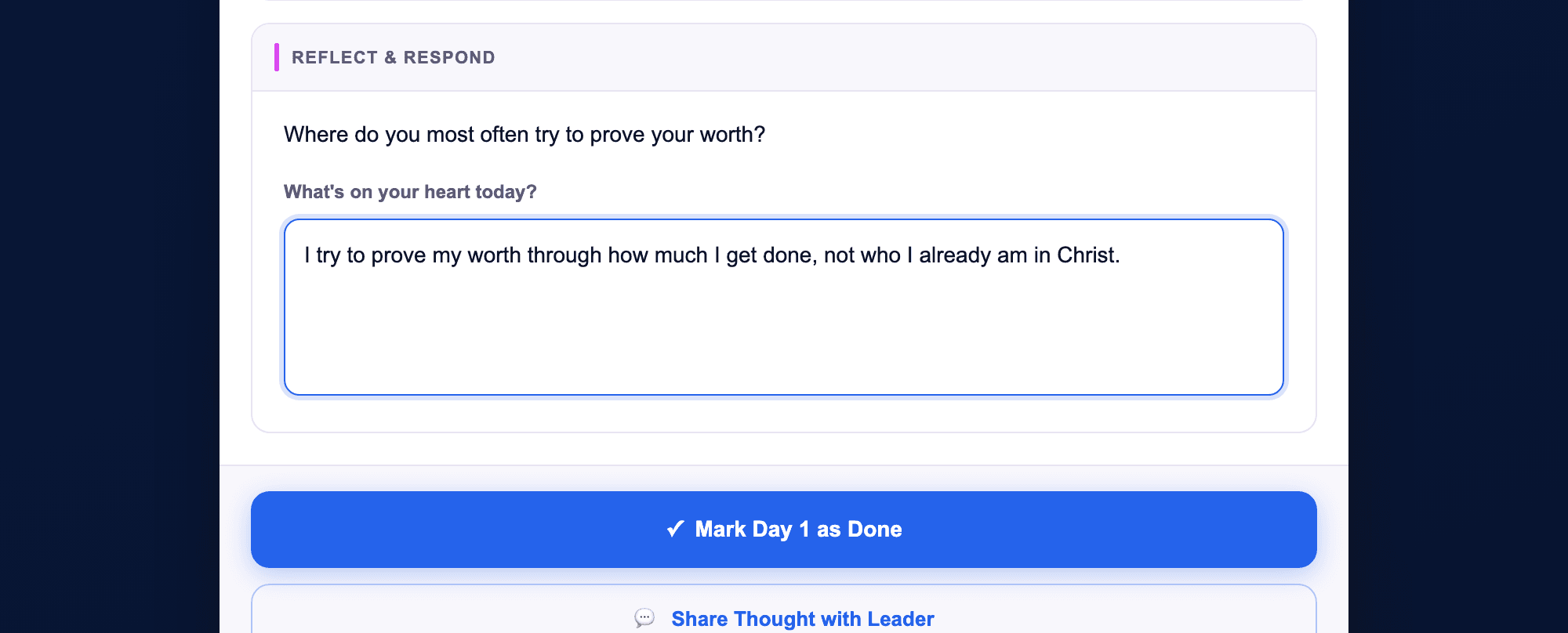
A leader can then respond directly, and the participant sees that response against their own journey. The distinction between private and shared isn't a setting buried in a menu — it's built into how the two actions are presented to the participant in the first place.
Try this this week
Write down, in one or two sentences, how your church currently explains to participants what happens to what they write. If you're not sure they'd get the same answer from two different leaders, that's worth fixing first.
Related resources