When Church Follow-Up Depends on Who Remembers
Nobody is uncaring. The process simply depends on someone remembering — and memory is not a process.
5 min read
Someone has stopped engaging. One leader half-remembers a conversation about it. Another assumes someone else has already called. A message about it exists somewhere in a WhatsApp thread nobody can quite find. Nobody is uncaring — the process simply depends on memory.
This is one of the most common ways good pastoral intentions quietly fail. Not through neglect, but through a process with no fixed place for information to live and no clear owner for the next action.
The problem isn't the leaders
It's tempting to read a missed follow-up as a lack of diligence. Usually it isn't. It's a structural problem: information is fragmented across conversations, group chats and someone's memory (a pattern explored further in When Discipleship Lives Across WhatsApp, Spreadsheets and Leader Notes), ownership is implicit rather than assigned, and disengagement is only noticed once it has already become a pattern — by which point the conversation is harder to have.
A model that doesn't rely on anyone's memory
Good pastoral care should not require leaders to remember everything. It should rely on four things working together.
- Visibility — one place where a person's current status is genuinely visible, not scattered across notebooks and chat threads.
- Ownership — one named leader responsible for noticing that status, not a shared responsibility that quietly belongs to no one.
- Signal — a clear, agreed definition of what should trigger a conversation. "Missed two sessions," not "a vague sense something's off."
- Action — a known, simple next step once the signal fires, so noticing something doesn't stall for lack of a plan.
Remove any one of these and the whole thing degrades back into memory. Visibility without ownership means everyone can see the problem and nobody acts. Ownership without a clear signal means a leader is responsible for noticing something that was never defined.
Defining your own signal
Every church's signal will look slightly different, but it should be specific enough that two different leaders would agree on whether it has fired. Useful starting questions:
- How many missed sessions, or how many days of no progress, count as worth a conversation?
- Does a private struggle shared with a leader count as a signal on its own, separate from attendance?
- Who is the one person who sees that signal first?
- What is the very first action they take — a text, a call, a coffee — once it fires?
Write the answers down. A signal that only exists in someone's head is just memory again, with extra steps.
A worked example
Take a specific case. Someone attends week two of a course, then misses week three. Under a memory-based process, whether anyone notices depends on whether the leader who ran week two happens to also be leading week three, and whether they happen to remember who was in the room the previous session. If either of those doesn't hold, the gap simply passes unnoticed.
Under the four-part model above, none of that coincidence is required. A missed session is the defined signal. A specific leader owns noticing it, regardless of who happened to teach that week. Reaching out is the known next action, not something that has to be improvised in the moment. The outcome doesn't depend on which leader happened to be paying close attention — it happens the same way every time, for every person.
How to put this into practice in ChurchPathways
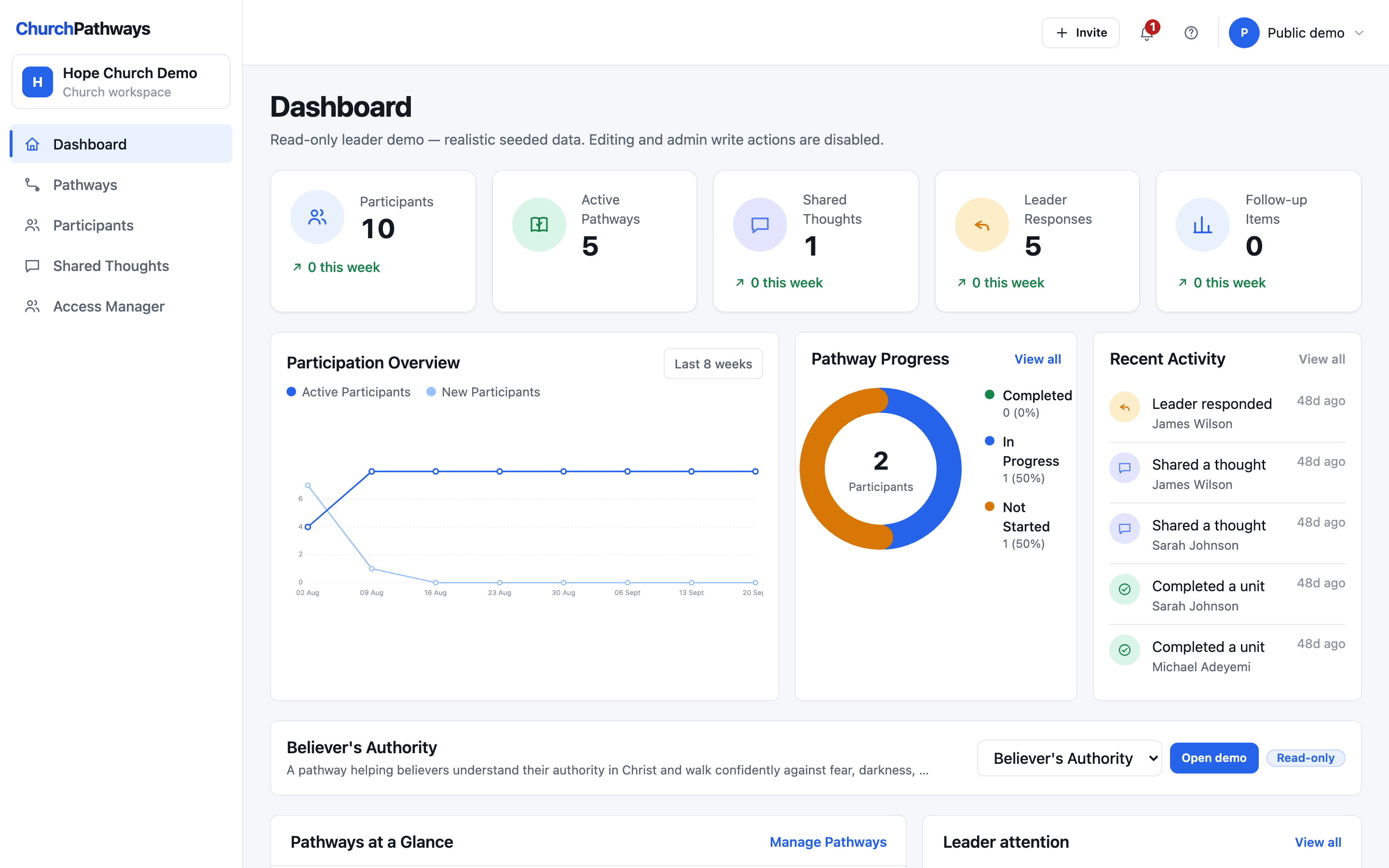
The Dashboard gives a leader one place to see how participants are moving through their assigned pathways, so a pause in progress is something a leader can notice rather than something they have to remember to ask about.
What a participant chooses to share arrives in one inbox for leaders, each with a status showing whether it's still awaiting a reply. Nothing written privately ever appears here — only what was intentionally shared.
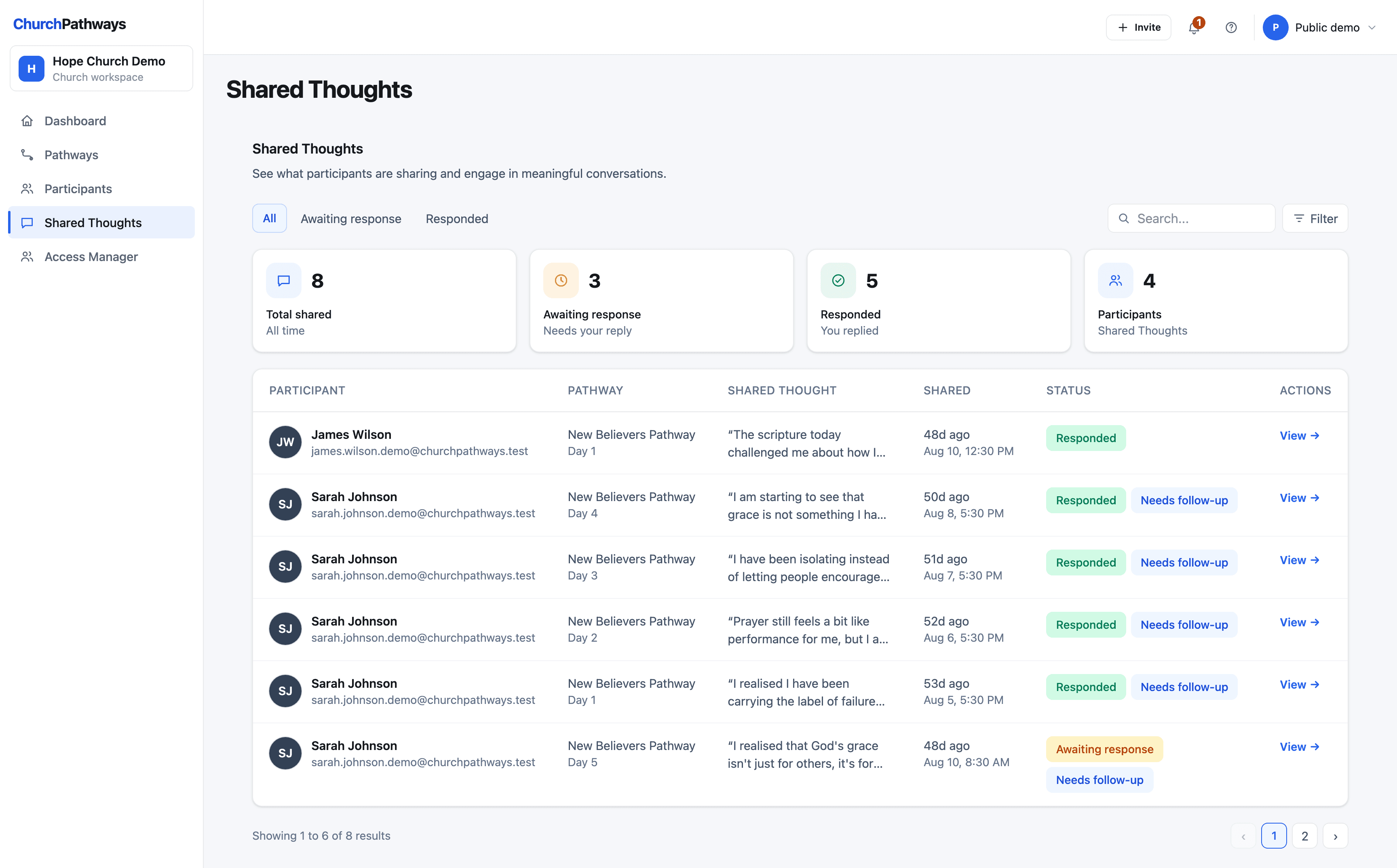
None of this replaces a leader's judgement about who needs a phone call this week. What it removes is the dependency on any one person remembering everything — the status is visible, and a leader can decide what to do about it.
Try this this week
Pick one person your church hasn't followed up with recently. Write down what should have triggered a conversation, who was supposed to notice, and when.
Related resources