What Happens After Someone Becomes a Christian at Your Church?
The moment of decision usually gets warmth and attention. The weeks after it often don't. Here is a simple way to make sure that changes.
5 min read
A person responds to the gospel on Sunday. There are tears, maybe a name written on a card, a warm conversation at the front. Monday arrives. Who owns what happens next?
Most churches are genuinely good at the moment itself. Someone prays with the person, welcomes them, perhaps introduces them to a leader. The difficulty tends to start a few days later, once the initial encouragement has passed and the person is simply a name that needs following up.
What's actually going wrong
It is rarely a lack of care. Look closely and the same few problems show up in church after church.
- Responsibility is assumed rather than assigned. Everyone believes someone else is following up.
- There is no defined next step beyond a general invitation to keep attending.
- Progress becomes invisible once the initial conversation ends, so nobody notices if it stalls.
- The new believer doesn't know what to expect, so they wait to be told rather than taking initiative themselves.
None of this reflects a lack of love. It reflects a process that depends on someone remembering, at the exact moment their attention is on ten other things.
A simple framework: welcome, ownership, one step, visibility
A workable new-believer process doesn't need to be elaborate. It needs four things to be true for every single person, every single time.
- Welcome that continues past the first conversation — a message or call within a few days, not just a greeting on the day.
- One named person responsible for them. Not a team, not "whoever's free" — a specific person whose job it is to notice if this relationship goes quiet.
- One clear next step. Not a general invitation to "keep coming" — a specific, small, doable action: attend a short course, meet a leader for coffee, join a particular group.
- A way for leaders to see whether the step was taken. If progress is invisible, follow-up depends entirely on memory, and memory is not a process.
This works whether a church has fifteen people or fifteen hundred. What changes with size is not the framework — it's how much a church needs a system to hold it, rather than one person's diary.
What to do this week, practically
Before the next person responds to the gospel in your church, answer four questions in writing.
- Who, by name, takes responsibility for this person in the first month?
- What is the one thing you want them to do next?
- How will you know whether they've done it?
- What happens if three or four weeks pass with no contact?
If you can't answer these four questions right now for the last person who became a Christian at your church, that's the gap worth closing first — not a new programme, just a clear answer to each one.
How to put this into practice in ChurchPathways
If your church uses ChurchPathways, there's a ready-made starting point for this in the Pathways library.
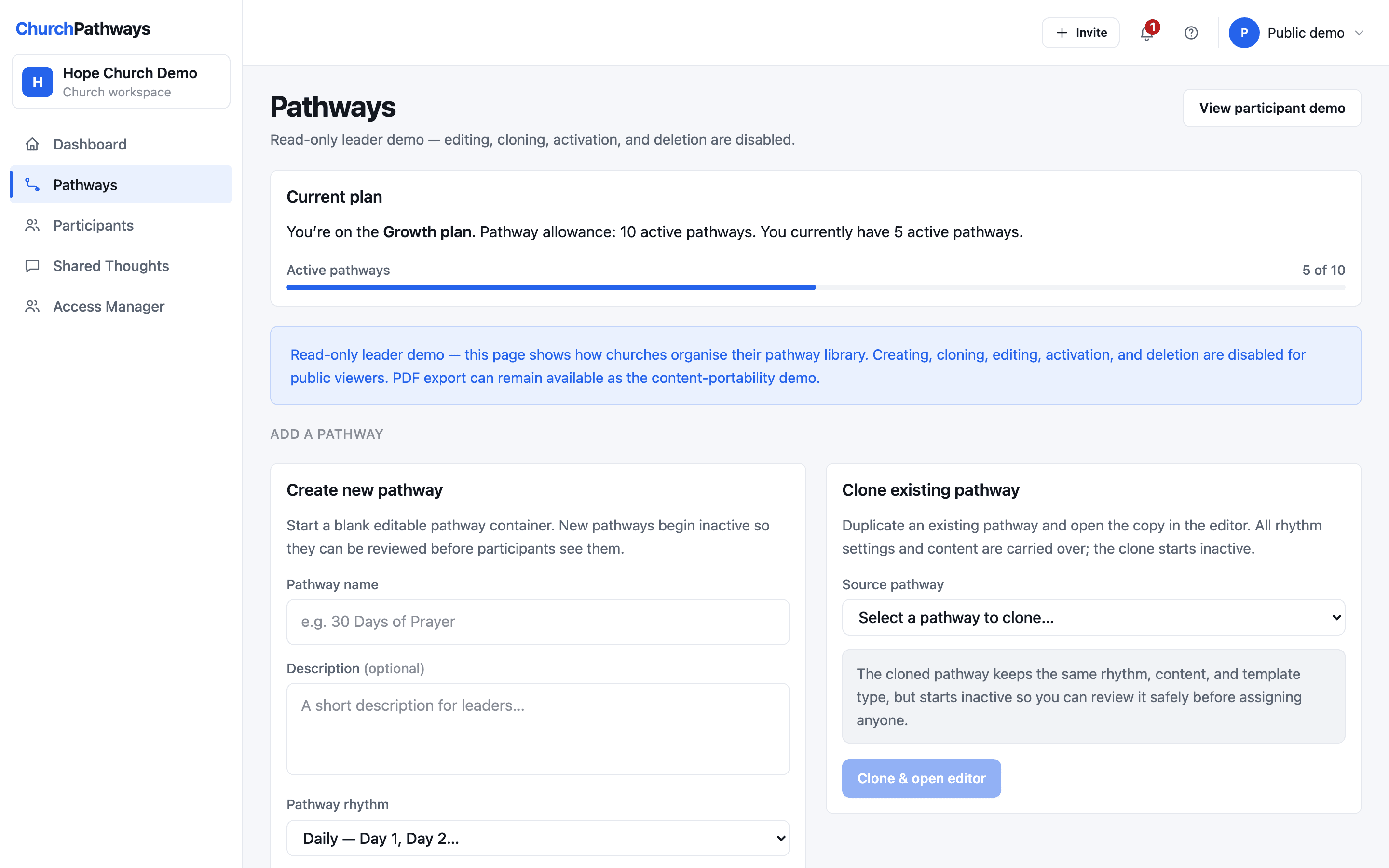
ChurchPathways includes a New Believers Pathway as a starting point in the Pathways library. A leader can review and adapt its content to their own church's language before it's ever seen by anyone, then activate it once they're happy with it.
- Open the New Believers Pathway from the Pathways library and review its content.
- Adapt the language to fit your own church, then activate it when ready.
- Assign it to a specific new believer.
Once assigned, a participant sees one day of their pathway at a time, with a short reflection prompt and a clear next action, rather than the whole course at once.

A starter pathway is a structure, not a replacement for the relationship. It gives a new believer something concrete to do between conversations with the person who is actually responsible for them — it doesn't do the pastoral work itself.
It's also only the first step of a longer journey. Once someone finishes it, the same question applies again in a different form — see Your Discipleship Course Finished. What Happens Next?.
Try this this week
Before it happens again, decide who in your church will take responsibility for the next new believer by name, not by team. Write down the one thing you'll ask them to do first.
Related resources