From First Sunday to Belonging: Giving New Members a Clear Pathway
Someone likes what they've found and wants to get more involved. The path from visitor to belonging is often communicated informally, if at all.
5 min read
Someone has attended a few Sundays. They like what they've found. They want to get more involved — but the path from visitor to belonging is mostly communicated informally, in a hallway conversation with whoever happens to notice them.
This works reasonably well when a church is small enough that everyone notices new faces. It stops working as soon as a church grows past that point, or as soon as the noticing depends on which particular leader is on duty that week.
Belonging usually has a shape, even when nobody's written it down
Ask most church leaders how someone moves from visitor to fully belonging, and they can describe it in general terms. Ask them to write it down as a specific sequence a new person could follow, and it's often much less clear. The shape exists; it just hasn't been made explicit enough to hand to someone.
A progression to adapt, not adopt wholesale
Every church's version of this will look different, particularly around the membership or belonging step, which varies significantly between traditions. A workable shape usually includes something like the following.
- Welcome — a genuine, specific acknowledgement that someone is new, not just a general greeting.
- Understanding the church — what this church actually believes and how it operates, in plain terms.
- Meeting people — a specific, low-pressure way to build a couple of real relationships.
- Discovering groups or serving — an invitation into something ongoing, not just one-off events.
- A membership or belonging step, depending on your church's own model and language for this.
- Ongoing discipleship — a next journey, so belonging leads somewhere rather than becoming a plateau.
Not every church formalises step five as membership in the traditional sense, and that's fine — the point of the sequence is the progression, not any particular label along the way. The final step deserves its own attention too, since Your Discipleship Course Finished. What Happens Next? is exactly what stops belonging from becoming a plateau.
Make the informal parts explicit
The steps that tend to go missing aren't the formal ones — most churches already have a membership class or an equivalent. It's the earlier, informal steps: understanding the church, meeting people, discovering where to serve. These often exist only as things that happen to people who are lucky enough to be noticed.
If your church can describe its membership process in detail but struggles to describe what happens between someone's first Sunday and that class, that gap is usually where people quietly drift away.
This gap matters more than it might seem, because it's usually the point where a genuinely interested person either becomes known to the church or simply keeps attending anonymously for months. Nobody decides to stay anonymous — it happens by default when nothing specific invites them further in.
How to put this into practice in ChurchPathways
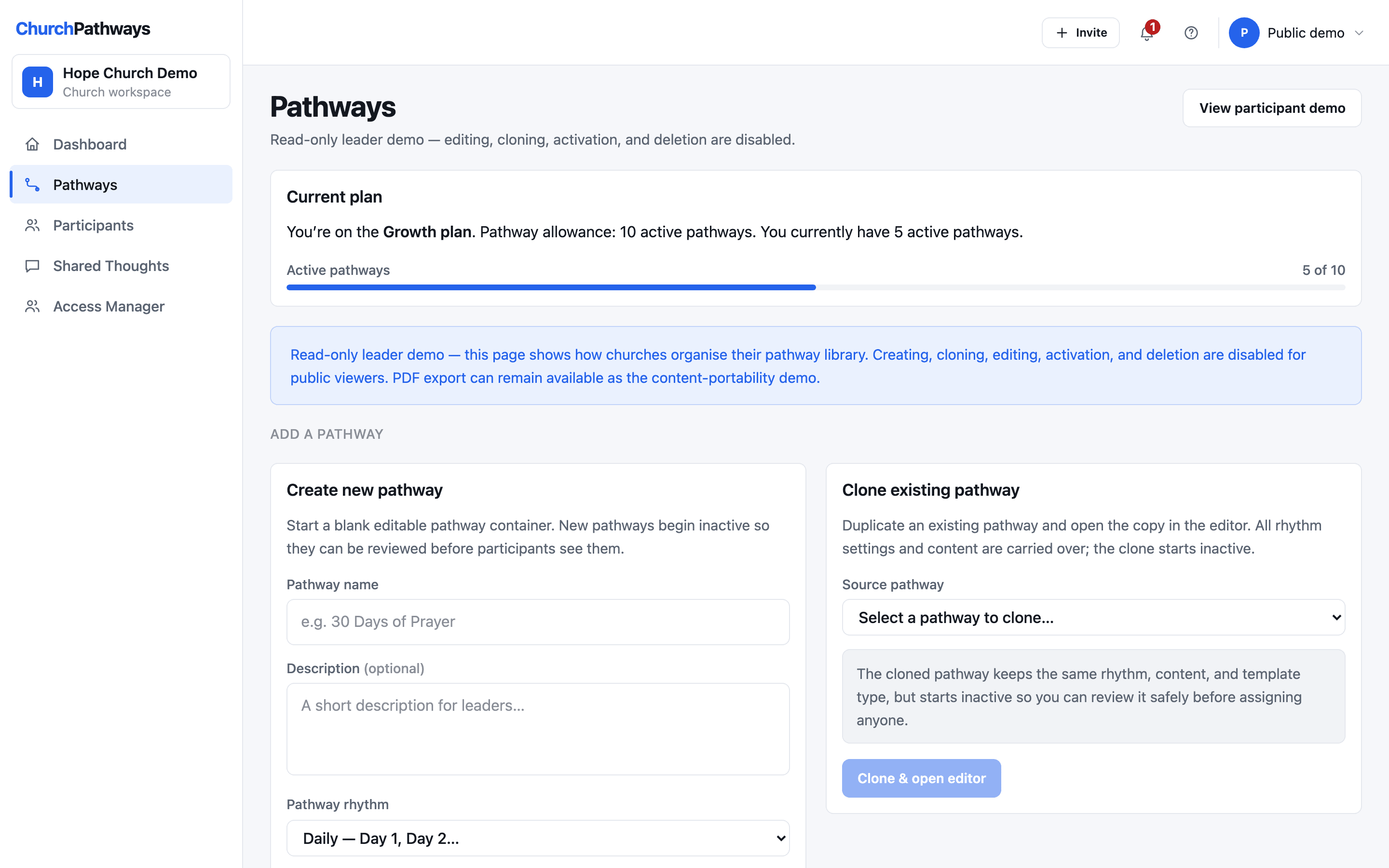
A church doesn't need to rely only on the included New Believers starter pathway for this. Any church can create its own pathway from scratch for this earlier belonging journey, using its own language, sessions and rhythm.
A church isn't limited to the included starter content. A new pathway can be created with its own rhythm — daily, weekly, or session-based — written and reviewed while inactive, and activated only once it's ready.
- Choose the rhythm that fits the journey: daily, weekly, or session-based.
- Write and review the content while the pathway stays inactive.
- Activate it, then assign it to the people it's for.
Once assigned, a participant sees one day of their pathway at a time, with a short reflection prompt and a clear next action, rather than the whole course at once.

Once built, that pathway can be assigned to anyone the church wants to walk through it — a recent first-time attender, someone who's expressed interest, or a whole group being welcomed together. Each person moves through the same sequence, with the same clear next step, regardless of which leader happens to meet them first.
Try this this week
Ask yourself: if someone attended for the first time last Sunday and wanted to get more involved, what is the specific next thing they'd be invited to do? If the honest answer is "it depends who they happen to talk to," that's the gap to close.
Related resources