A Simple Way to Build a Consistent Baptism Preparation Journey
Two people preparing for baptism at the same church can have very different experiences, depending on who happens to be leading them that month.
5 min read
Two people preparing for baptism at the same church can have noticeably different experiences, depending on who happens to be leading them, how much time that leader has that month, and what's come up in conversation along the way.
Churches differ genuinely on baptism theology, timing and practice, and that's not something this article is trying to settle. What follows isn't a theology of baptism — it's a practical shape for preparation, so that consistency doesn't depend entirely on which leader someone happens to be paired with.
Why preparation drifts
Without a shared structure, baptism preparation naturally becomes whatever each leader personally emphasises. One leader might focus heavily on personal testimony, another on doctrine, another mostly on logistics. None of that is wrong on its own — the drift becomes a problem when two people in the same church end up meaningfully underprepared or overprepared compared to each other, simply due to who they were assigned.
A sample framework — adapt it freely
This is an example structure, not doctrine. Change the number of sessions, the order, or the content entirely to match your own church's practice.
- Session 1 — What baptism means in this church, in your own church's own words and theology.
- Session 2 — The person's own faith story, and preparing what they might share on the day.
- Session 3 — Practical preparation: what happens on the day, and space for remaining questions.
- Session 4 — Baptism day itself, and a clear next step into ongoing discipleship afterwards.
The fourth session matters more than it might look. Baptism, like any discipleship course, can end with warmth and then nothing obvious next — the same gap covered in Your Discipleship Course Finished. What Happens Next?. Deciding the next step in advance — a small group, a follow-up conversation, a next pathway — prevents it.
What this protects, beyond consistency
A shared outline isn't only about fairness between two people preparing at the same church, though that matters. It also protects the leader doing the preparing. Baptism conversations often touch on genuinely difficult material — doubt, past hurt, complicated family reactions — and a leader without a structure to fall back on can find themselves either avoiding those subjects or handling them without much of a plan.
A written outline doesn't solve that on its own, but it does mean the leader isn't also having to invent the shape of the conversation while having it. That's one less thing to carry into what is often, for both people, an emotionally significant few weeks.
What consistency actually requires
Consistency doesn't mean every conversation sounds identical. It means every person going through preparation covers the same core ground, regardless of who is leading them. A written outline — even a simple one — is usually enough to close most of the gap. The outline doesn't replace the leader's own pastoral conversation; it just ensures nothing essential is left to chance.
Introducing this doesn't require announcing a policy change. The simplest route is usually to write the outline once, share it with whoever currently leads baptism conversations, and ask them to use it as a starting point rather than a script. Most leaders welcome a shared structure — it removes the pressure of having to remember everything themselves, and it protects them if they're covering for someone else at short notice.
How to put this into practice in ChurchPathways
Once a church has its own preparation outline, it can be built as a pathway rather than left as a document a leader might or might not follow.
A church isn't limited to the included starter content. A new pathway can be created with its own rhythm — daily, weekly, or session-based — written and reviewed while inactive, and activated only once it's ready.
- Choose the rhythm that fits the journey: daily, weekly, or session-based.
- Write and review the content while the pathway stays inactive.
- Activate it, then assign it to the people it's for.
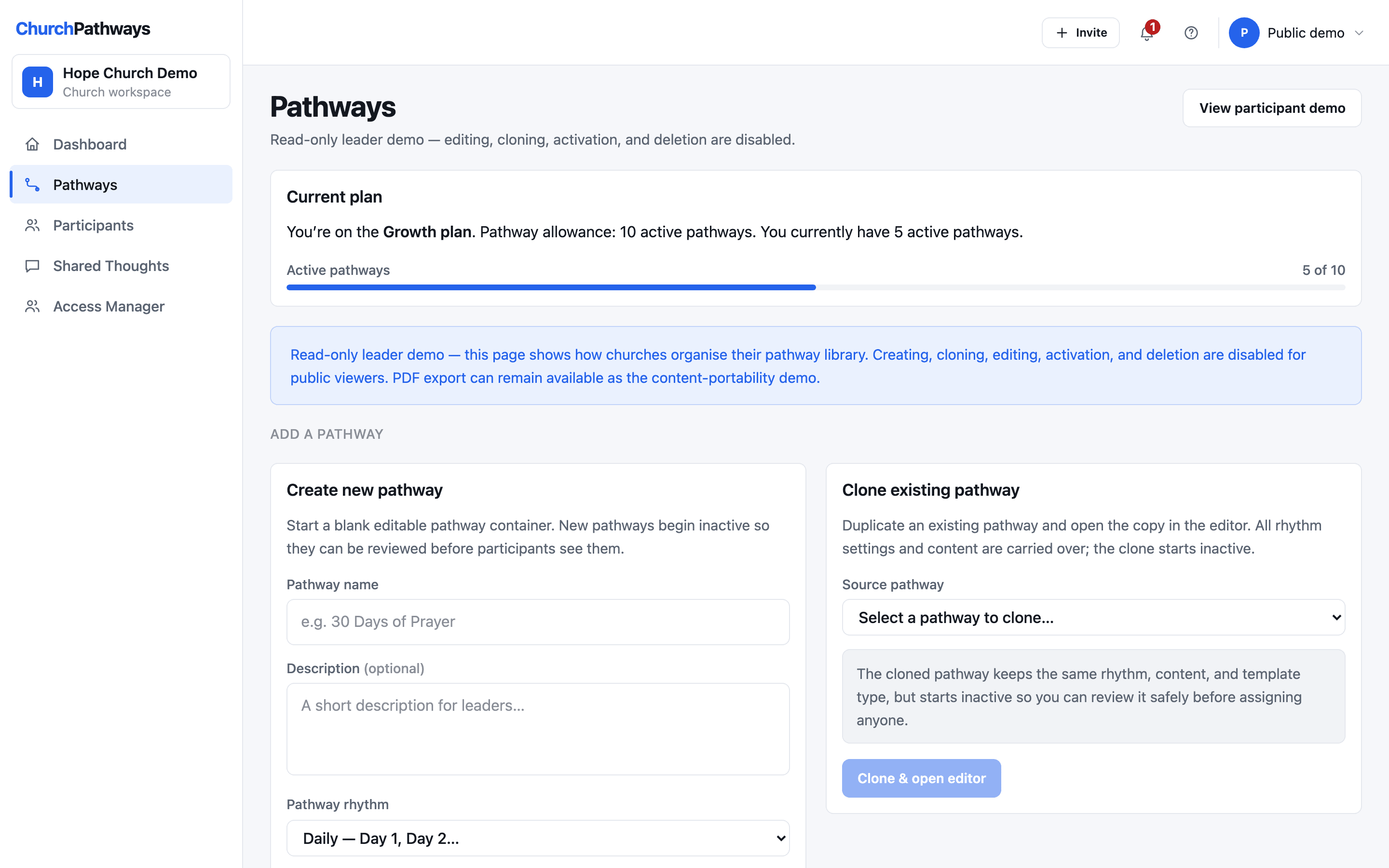
From there, it can be assigned consistently to every person preparing for baptism — the same core content, the same sessions, the same intended next step, however many leaders are involved in delivering it.
Try this this week
Sketch your own four-session baptism preparation outline using your church's own language and theology. You don't need to build anything yet — just write down what each session is for.
Related resources